


2026 Hungarian parliamentary election

 | ||||||||||||||||||||||||||||||||||||||||||||
12 April 2026
| ||||||||||||||||||||||||||||||||||||||||||||
All 199 seats in the National Assembly 100 seats needed for a majority | ||||||||||||||||||||||||||||||||||||||||||||
|---|---|---|---|---|---|---|---|---|---|---|---|---|---|---|---|---|---|---|---|---|---|---|---|---|---|---|---|---|---|---|---|---|---|---|---|---|---|---|---|---|---|---|---|---|
| Opinion polls | ||||||||||||||||||||||||||||||||||||||||||||
| ||||||||||||||||||||||||||||||||||||||||||||
 | ||||||||||||||||||||||||||||||||||||||||||||
.jpg)
.jpg)
.jpg)
.jpg)
Parliamentary elections are to be held in Hungary on 12 April 2026.[1] This parliamentary election will be the 10th since 1990.
Background
2022 election
On 3 April 2022, with 54.13% of the popular vote, Fidesz–KDNP received the highest vote share by any party or alliance since 1990 and won two-thirds of the seats for the fourth time. The United for Hungary alliance suffered a massive defeat and was shortly after dissolved, its members sat in separate political groups in the National Assembly. From other minor parties, only Our Homeland Movement reached the threshold for entry, while the Hungarian Two Tailed Dog Party did not.[2] Following the election, only the Democratic Coalition managed to achieve sustained double-digit poll results alongside Fidesz, but still lagged far behind the ruling parties.[3][4]
Rise of TISZA

.jpg)
On 2 February 2024, it was revealed that President Katalin Novák had granted a pardon in April 2023 to a criminal involved in a pedophilia case.[5] The scandal resulted in Novák's resignation, as well as that of former justice minister Judit Varga, who had countersigned the pardon.[6] Not long after, Varga's ex-husband Péter Magyar published a Facebook post declaring that he would resign from all of his government-related positions, stating that the past few years had made him realize that the idea of a "national, sovereign, bourgeois Hungary" stated as the goal of Viktor Orbán's rule was in fact a "political product" serving to obscure massive corruption and transfers of wealth to those with the right connections.[7]
On 15 March 2024, Magyar, despite initially refusing his participation in politics, held a rally attended by tens of thousands in Budapest at which he announced the formation of a new political party.[8] According to polling conducted that month, around 15% of voters claimed they were "certain or highly likely" to vote for Magyar if he ran for office.[9]
On 10 April 2024, Magyar announced his bid to run both in the European and Budapest Assembly elections with the at that point unknown Respect and Freedom Party, which finished in second place with nearly 30% of votes, the highest number and percentage of votes by any non-Fidesz party since 2006, eventuating collapse for other opposition parties with it and a new situation in Hungarian politics. Following the midterm elections, the strengthening of the Tisza Party continued and according to the independent/opposition-aligned polls, by the end of the year it had become the most popular political party in Hungary, or at least a close competitor to Fidesz, thus overturning the continuous dominance of ruling parties that had lasted since the Őszöd speech came to light.[10][11] Following this, some opposition parties, such as Everybody's Hungary People's Party and Momentum Movement, have decided not to run in the next election in the interest of government change.[12][13]
In January 2026, three opposition parties – Solution Movement, Second Reform Era Party and the parliamentary force LMP – Hungary's Green Party – had announced within a week that they will not run in the parliamentary election. The LMP party congress declared that "we do not wish to hinder the change of government, so we are not setting up a list or nominating candidates".[14]
Amendment of the electoral law
On 17 December 2024, the National Assembly voted on changes to the constituencies. As a result, the number of electoral districts in Budapest decreased from 18 to 16, while in Pest County the number of districts increased from 12 to 14. Border changes in some parts of Csongrád-Csanád County and Fejér County also happened. The ruling Fidesz–KDNP made the decision citing changes in the results of latest census (2022), but according to the opposition, the real goal was to weaken their position in those, mainly capital districts, where they were previously elected directly.[15] The changes have been accused of amounting to gerrymandering, with the opposition Tisza Party needing to win by around 3–5 points in the national vote in order to get a majority in the Assembly.[16]
Abolished constituencies
New constituencies
Tisza primary
The Tisza party selected 103 of its 106 future candidates for the election in a two-round primary late 2025 (following a call for candidates in 2024). The party put forward 3 nominees in each district (except the district of Magyar and 2 seats) and in the first round all Tisza Sziget members above the age of 16 could vote. Voting took place via a modified Borda count. In the second round, voting was opened also to all resident citizens above 18 who could vote for either of the two advancing candidates. Winners were announced on 28 November 2025.
Electoral system
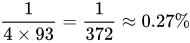
The 199 members of the National Assembly will be elected by mixed-member majoritarian representation with two methods; 106 elected in single-member constituencies by first-past-the-post voting, while the other 93 elected from a single nationwide constituency, by modified proportional representation. The electoral threshold is set at 5% for single party lists, 10% for joint lists of two parties and 15% for joint lists of three or more parties. Since 2014, each of the Armenian, Bulgarian, Croatian, German, Greek, Polish, Romani, Romanian, Rusyn, Serbian, Slovak, Slovenian, and Ukrainian ethnic minorities can win one of the 93 party lists seats if they register as a specific list and reach a lowered quota of of the total of party list votes. Each minority is able to send a minority spokesman – without the rights of an MP – to the National Assembly, if the list does not reach this lowered quota.[17] Fractional votes, calculated as all the votes of individual candidates not elected (but associated with a party list over the threshold), as well as surplus votes cast for successful candidates (margin of victory minus 1 vote), are added to the direct lists votes of the respective parties or alliances. Seats are then allocated using the D'Hondt method.[18]
Endorsements
- Heads of state and government
- Donald Trump, President of the United States (2017–2021; 2025–present)[19]
- Vladimir Putin, President of Russia (2000–2008; 2012–present)[20]
- Javier Milei, President of Argentina (2023–present)[19]
- Aleksandar Vučić, President of Serbia (2017–present)[19]
- Georgia Meloni, Prime Minister of Italy (2022–present)[19]
- Benjamin Netanyahu, Prime Minister of Israel (1996–1999; 2009–2021; 2022–present)[19]
- Andrej Babiš, Prime Minister of the Czech Republic (2017–2021; 2025–present)[19]
- Mateusz Morawiecki, Former Prime Minister of Poland (2017–2023)[19]
- Matteo Salvini, Deputy Prime Minister of Italy (2018–2019; 2022–present)
- Party leaders
- Alice Weidel, Leader of the Opposition in Germany (2017–2021; 2025–present)[19]
- Marine Le Pen, President of the National Rally (2011–2021)[19]
- Herbert Kickl, Chair of the Freedom Party of Austria (2021–present)[19]
- Santiago Abascal, President of Vox (2014–present)[19]
- Notable individuals
- Rob Schneider, American actor and comedian[21]
- Heads of state and government, EU officials
- Donald Tusk, Prime Minister of Poland (2007–2014; 2023–present)[22]
- Manfred Weber, President of the European People's Party (2022–present)[23]
- Former executive-branch officials
- Géza Jeszenszky, Former Minister of Foreign Affairs of Hungary (1990–1994)[24]
- Local officials
- Gergely Karácsony, Lord Mayor of Budapest (2019–present)[25]
- Péter Márki-Zay, Mayor of Hódmezővásárhely (2018–present)[26]
- László Botka, Mayor of Szeged (2002–present)[27]
- Notable individuals
- András Bálint, actor, former Director of the Radnóti Miklós Theatre[28]
- Parties
Opinion polls
Total
The following graph presents the average of all polls.

By affiliation
The following two graphs present only the polls that are government-aligned, or independent/opposition-aligned, respectively.
-
.svg/500px-2026_Hungarian_election_polls_(Government-aligned).svg.png) Government-aligned polls
Government-aligned polls -
.svg/500px-2026_Hungarian_election_polls_(Independent-Opposition-aligned).svg.png) Independent/Opposition-aligned polls
Independent/Opposition-aligned polls
.svg)
.svg)
Notes
- ^ As Fidesz leader
- ^ The party was founded in 2020 but did not run in the 2022 Hungarian parliamentary election.
- ^ As part of United for Hungary
References
- ^ "Hungary sets April 12 election date as Orbán faces tough challenge". AP News. 13 January 2026. Retrieved 13 January 2026.
- ^ "Nemzeti Választási Iroda". valasztas.hu. 3 April 2022.
- ^ "Árnyékkormányt alakít Dobrev Klára". telex.hu. 16 September 2022.
- ^ "Molnár Csaba: Egy dolgot nem próbált még az ellenzék 2010 óta, hogy legyen egy domináns párt". telex.hu. 6 February 2023.
- ^ "Children's home crisis threatens very foundation of Orban regime, say analysts". www.intellinews.com. 14 February 2024. Retrieved 30 March 2024.
- ^ Thorpe, Nick (10 February 2024). "Hungarian President Katalin Novak resigns over child-abuse pardon scandal". BBC. Retrieved 27 March 2024.
- ^ "Varga Judit volt férje: Egy percig sem akarok olyan rendszer részese lenni, amelyben Tónik, Ádámok és Barbarák vígan röhöghetnek a markukba". telex (in Hungarian). 10 February 2024. Retrieved 30 March 2024.
- ^ "Thousands protest in Budapest as Orban embroiled in corruption scandal". euronews. 26 March 2024. Retrieved 30 March 2024.
- ^ "In Hungary, Scandal and Crisis Suddenly Energize the Opposition". thebulwark. 18 March 2024. Retrieved 18 March 2024.
- ^ "Magyar Péter: Történelmet írunk, 18 éve nem volt ilyen". 24.hu (in Hungarian). 23 October 2024. Retrieved 23 October 2024.
- ^ "Silence engulfs pro-government polling institutions". 24.hu (in Hungarian). 25 June 2025. Retrieved 24 September 2025.
- ^ "Márki-Zay pártja nem indul a választáson". 444.hu (in Hungarian). 1 June 2025. Retrieved 1 June 2025.
- ^ "Nem indul a Momentum a 2026-os országgyűlési választáson". telex.hu (in Hungarian). 7 June 2025. Retrieved 7 June 2025.
- ^ "Az LMP sem indul az idei választásokon". telex.hu (in Hungarian). 17 January 2026. Retrieved 18 January 2026.
- ^ "Megszavazták a választási törvény módosítását". 24.hu. 17 December 2024.
- ^ "Gerrymandered districts, manipulated polls: Orbán's party banks on local races to win 2026 elections". Atlatszo. 25 August 2025. Retrieved 31 August 2025.
- ^ Nemzeti Választási Iroda National Election Office
- ^ "Electing Members of the National Assembly - House of the National Assembly - Országgyűlés". House of the National Assembly. Retrieved 28 February 2025.
- ^ a b c d e f g h i j k "Europe's right-wing elite (and Netanyahu) endorse Orbán in Hungary election race". POLITICO Europe. POLITICO. Retrieved 16 January 2026.
- ^ "Putin Endorses Orbán, Says Majority of Hungarians Will Vote for Him in 2026". Hungarian Conservative. Retrieved 3 October 2025.
- ^ Edwards, Christian (16 January 2026). "Rightwingers of the world unite to endorse Orbán ahead of Hungary's election". CNN. Retrieved 19 January 2026.
- ^ Origo (1 November 2025). "Magyar Péter szövetségese nyíltan fenyeget, elszabadult az erőszak". ORIGO (in Hungarian). Mediaworks Hungary Zrt. Retrieved 16 January 2026.
- ^ a b Scheffer, Joakim (30 April 2025). "Re-Elected EPP Chief Manfred Weber Sends Clear Message to Hungary". Hungarian Conservative. Hungarian Conservative. Retrieved 16 January 2026.
- ^ "Jeszenszky Géza is kiment Magyar Péter somlóvásárhelyi beszédére". Telex.hu (in Hungarian). Retrieved 24 August 2025.
- ^ "Karácsony Gergely szerint Magyar Péter alkalmas miniszterelnöknek, drukkol az ellenzéknek". Népszava.hu (in Hungarian). Retrieved 3 December 2025.
- ^ a b "Márki-Zay Péter pártja nem indul a 2026-os választáson". HVG (in Hungarian). HVG Kiadó Zrt. 1 June 2025. Retrieved 16 January 2026.
- ^ "Összenő, ami összetartozik: volt MSZP-s miniszterelnök-jelölt állt be a Tisza mögé". Magyar Nemzet (in Hungarian). Retrieved 22 January 2026.
- ^ Mázsár, Tamás (13 April 2024). "Bálint András: Azt mondtam Magyar Péternek, hogy ha szükséged van egy nemzeti liberálisra, akkor jövök". 24.hu (in Hungarian). Central Médiacsoport Zrt. Retrieved 16 January 2026.
- ^ "Opposition Party Bows Out of 2026 Race amid Shifting Political Landscape". Hungary Today. Hungary Today. 10 June 2025. Retrieved 16 January 2026.
| Parliamentary elections |
|
|---|---|
| European elections | |
| Local elections | |
| Referendums | |
See also: List of Hungarian by-elections | |
